Professional water damage restoration equipment includes moisture meters, truck-mounted extraction units, LGR dehumidifiers, air movers, and HEPA air scrubbers working together to remove water and prevent secondary damage. I’ve walked through hundreds of water-damaged properties, and the equipment in the truck tells you almost everything about the outcome you’re going to get.
A flooded basement or a soaked commercial office doesn’t dry itself, and guesswork with the wrong tools turns a bad day into a mold problem three weeks later. Property owners rarely know what’s supposed to show up on a restoration truck, and that gap in knowledge costs people money and time they don’t have to lose.
I’m going to walk through the inspection and detection tools that find hidden moisture, the extraction and drying equipment that pulls water out and dries structures fast, the cleaning, sanitization, and mold prevention technology that protects health and air quality, and the monitoring, documentation, and professional selection process that ties it all together for both homes and commercial properties.
What Water Damage Restoration Equipment Actually Does
Restoration equipment exists to do three things fast: find water, remove it, and dry everything it touched before mold gets a foothold. I think of it as a chain: miss one link and the whole restoration slows down or fails outright.
Each piece of equipment on a restoration truck has a specific job. Moisture meters find what your eyes can’t see, extraction units pull standing water, and dehumidifiers finish the drying process once the bulk water is gone.
Core Equipment Categories at a Glance
Restoration equipment breaks into five functional groups: detection tools, extraction machines, drying equipment, air filtration systems, and monitoring technology. I use this breakdown with every property owner because it maps directly to the restoration timeline itself.
Detection comes first, extraction second, drying third, and air quality and monitoring run in parallel through the whole job. Skipping a category doesn’t skip the problem; it just delays it.
Why Equipment Choice Affects Restoration Outcomes
The equipment used on a job determines how fast a structure dries and whether hidden moisture gets missed. Structural drying that relies on undersized or consumer-grade equipment routinely takes twice as long as jobs using commercial-grade tools, and that extra time is exactly when mold starts growing.
I’ve seen properties “dried” with a couple of box fans that looked fine on the surface and were soaked behind the drywall. Professional equipment isn’t overkill; it’s the difference between a property that’s actually dry and one that just looks dry.
Moisture Detection and Inspection Tools
You can’t dry what you can’t find, and that’s the whole reason detection tools exist before extraction ever starts. I always start a job with these tools because they tell me exactly how far the water traveled.
Detection equipment reveals moisture trapped in walls, subfloors, and materials that look completely dry to the naked eye. This step decides which materials get saved and which need removal.
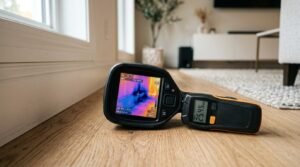
Moisture Meters (Pin and Pinless)
Pin meters measure moisture by inserting small probes into a material, while pinless meters use electromagnetic sensors to scan moisture content without damaging the surface. I reach for the pinless meter first on finished surfaces, then confirm depth readings with a pin meter when I need more precision.
Both tools read moisture content as a percentage, and that number tells me whether a material is drying on schedule or stuck. Wood, drywall, and concrete all have different acceptable moisture ranges, and knowing those benchmarks is what separates a guess from a verified dry.
Thermal Imaging Cameras and Hygrometers
A thermal imaging camera is a device that detects temperature differences across a surface to reveal moisture patterns invisible to the naked eye. Wet materials read cooler than dry surrounding areas on the camera, and that temperature contrast shows me the exact spread of water behind walls and ceilings.
Hygrometers measure relative humidity in the air, which tells me how much moisture the surrounding environment is holding onto. I pair both readings together because surface temperature and ambient humidity paint a much fuller picture than either tool gives alone.
Water Extraction Equipment
Once I know where the water is, extraction equipment gets the bulk of it out of the structure fast. This stage matters more than almost any other step, because every gallon removed mechanically is a gallon the dehumidifiers don’t have to fight later.
Extraction happens within the first hours of a job, and speed here directly shortens the entire drying timeline. Standing water left too long soaks deeper into subfloors, drywall, and framing.
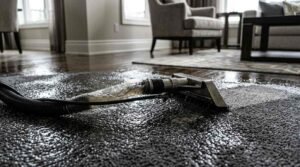
Truck-Mounted vs Portable Extraction Units
Truck-mounted extraction units pull water through long hoses connected to a powerful vacuum system housed in the service vehicle, giving far higher suction power than anything portable. I bring these out for large-scale flooding, commercial jobs, and situations with significant standing water across multiple rooms.
Portable extraction units run on standard power and work well for smaller, isolated water losses or spaces a truck-mounted hose can’t reach. Both tools do the same job at different scales, and choosing the right one comes down to water volume and site access.
Submersible Pumps and Wet Vacuums
A submersible pump is a self-contained pump designed to sit directly in standing water and move large volumes quickly, typically used when water depth exceeds a couple of inches. I deploy these first in flooded basements and crawl spaces before switching to extraction wands for the remaining shallow water.
Wet vacuums handle the finer extraction work after pumps clear the bulk volume, picking up water pumps can’t efficiently reach. Running both in sequence gets a space from flooded to merely damp in a fraction of the time either tool alone would take.
Structural Drying Equipment
Extraction gets the visible water out, but structural drying equipment finishes the job by pulling moisture out of materials and the air itself. This is the stage that takes the longest, and it’s also the stage most often rushed by anyone without professional equipment.
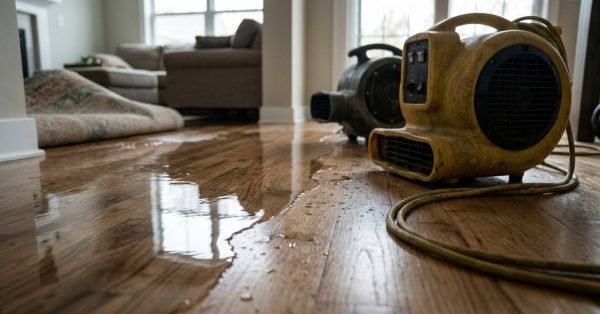
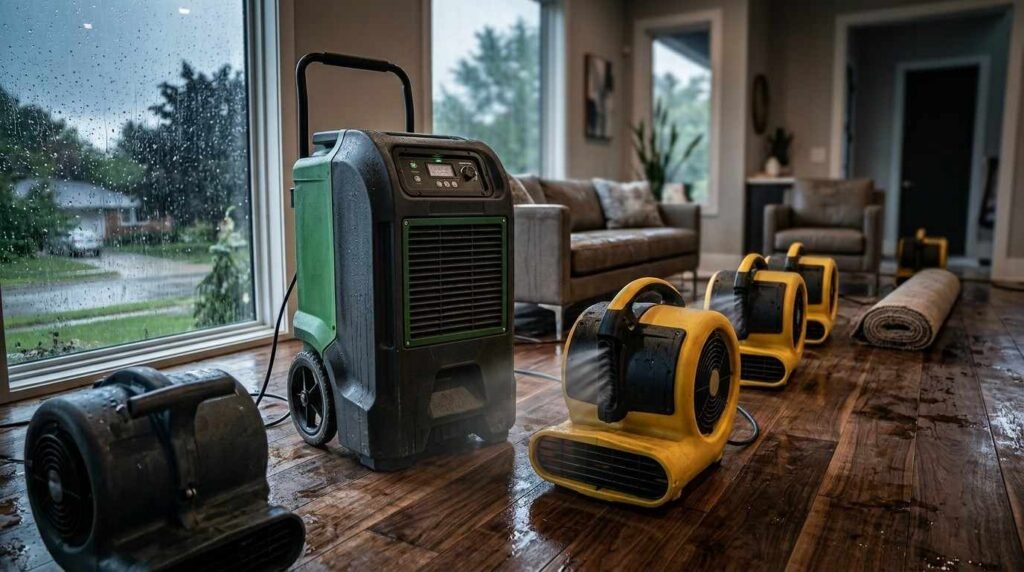
Air movers and dehumidifiers work as a team, and neither one does much good without the other. I set up the airflow pattern first, then size the dehumidification to match it.
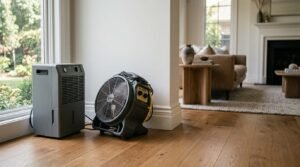
Air Movers and Axial Fans
Air movers are high-velocity fans engineered to accelerate surface evaporation by directing focused airflow across wet materials. I position them at specific angles along baseboards and walls to create consistent airflow that pulls moisture out of drywall and flooring evenly.
Axial fans move larger volumes of air at lower velocity, which works well for drying open areas rather than targeting specific wet surfaces. Combining both fan types across a job site keeps air circulating everywhere moisture might be hiding.
LGR Dehumidifiers vs Desiccant Dehumidifiers
LGR, or low-grain refrigerant, dehumidifiers cool air below its dew point twice to extract more moisture than standard refrigerant units, and I rely on them for most standard residential and commercial drying jobs. They perform best in moderate temperature environments with typical humidity loads.
Desiccant dehumidifiers use a chemical drying agent to pull moisture from the air and perform reliably even in cold conditions where refrigerant units lose efficiency. I switch to desiccant units on jobs in unheated spaces, crawl spaces, or during colder months when LGR performance drops off.
Air Scrubbers and Air Filtration Technology
Water damage doesn’t just soak materials; it kicks contaminants, spores, and particulates into the air, and that’s where air filtration equipment steps in. I treat this equipment as essential on any job involving contaminated water or visible mold growth, not optional.
Clean air during restoration protects both occupants and the technicians working the job. Skipping filtration on a contaminated job creates a health risk that lingers well past the visible cleanup.
HEPA Filtration for Airborne Contaminants
HEPA filtration is a filtration standard that captures at least 99.97% of airborne particles as small as 0.3 microns, including mold spores and fine dust. I run HEPA-equipped air scrubbers continuously on jobs with mold concerns or sewage-contaminated water, because those particles are exactly the size this filtration catches best.
The scrubbers pull air through multiple filtration stages before releasing clean air back into the space. Running these units throughout a job, not just at the end, keeps contaminant levels down while work is actively disturbing materials.
When Air Scrubbers Are Necessary
Air scrubbers become necessary whenever water damage involves category 2 or category 3 water, visible mold, or significant dust from material removal. I don’t run them on every clean-water job, but I never skip them once contamination enters the picture.
Indoor air quality during restoration work can drop well below acceptable particulate levels without active filtration running, based on EPA indoor air quality guidance. That’s reason enough to run scrubbers proactively rather than waiting for a problem to show up.
Cleaning, Sanitization, and Odor Control Equipment
Once materials are dry, cleaning and sanitization equipment addresses what the water left behind: bacteria, odors, and residue. I don’t consider a job finished just because the moisture meter reads dry; sanitization is what makes a space safe to live and work in again.
This equipment matters most on jobs involving contaminated water sources like sewage backups or floodwater. Skipping this stage leaves behind exactly the conditions that cause lingering odors and health complaints.
Antimicrobial Application Tools
Antimicrobial application equipment includes pump sprayers, foggers, and electrostatic sprayers that apply disinfectant solutions evenly across affected surfaces. I favor electrostatic sprayers for irregular surfaces because the charged particles wrap around edges and corners that a standard sprayer misses entirely.
These treatments target the bacteria and mold spores that survived initial cleanup, stopping regrowth before it starts. Proper application timing matters here; treating surfaces too early or too late reduces how effective the treatment actually is.
Ozone Generators and Hydroxyl Generators
Ozone generators produce ozone gas that neutralizes odor-causing molecules at a chemical level rather than just masking smell. I only run these in unoccupied spaces, since ozone at effective concentrations isn’t safe to breathe.
Hydroxyl generators achieve a similar odor-neutralizing effect using a safer process that allows people and pets to remain in the space during treatment. I choose between the two based entirely on whether the property needs to stay occupied during odor treatment.
Mold Prevention and Containment Technology
Mold prevention equipment exists to stop spore spread before it becomes a secondary disaster on top of the original water damage. I treat containment as non-negotiable the moment there’s any sign of existing mold growth or a job that’s run past the 24-to-48-hour window where mold risk climbs sharply.
This category of equipment protects unaffected areas of a property from contamination during active restoration work. Getting containment wrong turns a contained problem into a whole-building one.
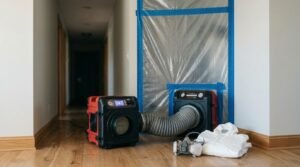
Negative Air Pressure Systems
A negative air pressure system is a controlled airflow setup that keeps air pressure inside a containment zone lower than the surrounding area, preventing contaminated air from escaping. I set these up any time mold remediation work happens alongside water restoration.
The system pulls air through HEPA filtration before exhausting it outside the containment zone. This setup keeps spores from drifting into clean parts of the property while remediation work is happening.
Containment Barriers and PPE
Containment barriers are physical plastic sheeting walls that physically separate a work zone from the rest of a property during remediation. I combine these barriers with negative air systems for any job involving visible mold, since one without the other leaves gaps in protection.
Personal protective equipment for technicians includes respirators, gloves, and protective suits rated for mold and contaminated water exposure. This equipment protects the people doing the work just as much as it protects the property itself.
Monitoring and Documentation Technology
Drying a property isn’t a “set it and walk away” process, and monitoring technology is what proves a job is actually progressing rather than just running equipment on a timer. I check readings daily on every active job because drying rates vary by material, temperature, and airflow.
Documentation also protects property owners during insurance claims by providing objective proof of the restoration process. This is the equipment category most homeowners never see but benefit from the most.
Remote Drying Monitoring Systems
Remote drying monitoring systems are wireless sensor networks that track moisture and environmental readings in real time and send that data to a technician’s device. I use these on larger commercial jobs where checking every room manually every day isn’t practical.
The sensors flag when a specific area stalls in its drying progress, letting me adjust equipment placement before it becomes a bigger delay. This kind of monitoring catches problems days before they’d show up on a routine walkthrough.
Psychrometric Software and Reporting Tools
Psychrometric software calculates the relationship between temperature, humidity, and moisture to determine whether drying equipment is performing efficiently in a given space. I run these calculations throughout a job to confirm equipment is sized correctly for the space and conditions.
Reporting tools compile moisture readings, equipment logs, and photos into documentation used for both quality control and insurance purposes. That paper trail becomes valuable the moment a property owner needs proof of what was done and why.
Residential vs Commercial Equipment Differences
Homes and commercial buildings both need drying, extraction, and filtration, but the scale and specifications of the equipment shift significantly between the two. I approach a flooded restaurant kitchen completely differently than I approach a flooded living room, even though the underlying principles stay the same.
Understanding this difference helps property owners set realistic expectations for equipment volume, technician count, and project timeline. Commercial jobs simply require more of everything and run at a higher capacity.
Scale and Capacity Requirements
Commercial properties typically need higher-capacity dehumidifiers, more air movers per square foot, and multiple extraction units running simultaneously to keep pace with larger affected areas. A single flooded office floor can require the same equipment volume as five or six residential water losses combined.
Residential jobs usually run efficiently with a handful of air movers and one or two dehumidifiers sized to the affected rooms. Scaling equipment correctly to the size of the loss is what keeps a job on schedule instead of stretching out for weeks.
Specialized Commercial-Grade Systems
Commercial-grade equipment includes desiccant dehumidification systems, large-capacity air scrubbers, and specialty extraction tools built for industrial flooring like concrete and epoxy coatings. I bring in this equipment for warehouses, medical facilities, and manufacturing spaces where standard residential tools simply can’t keep up with the volume or material types involved.
Facilities with sensitive equipment or inventory also require specialized humidity control to prevent secondary damage to electronics, documents, or stock. This is where commercial restoration diverges most sharply from residential work.
How Professionals Select the Right Equipment for Your Property
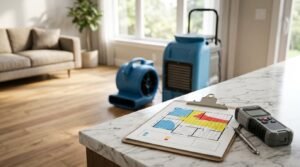
Choosing equipment isn’t a one-size-fits-all decision, and the selection process is where restoration expertise actually shows up. I walk a property before pulling a single piece of equipment off the truck, because the assessment determines everything that happens next.
Property owners rarely need to know every technical spec, but understanding how professionals make these decisions builds confidence in the process. It also explains why two seemingly similar water losses can require very different equipment setups.
Assessment Factors That Guide Equipment Choice
Technicians assess water category, material types affected, square footage, ambient humidity, and structural layout before selecting equipment. Category 3 contaminated water demands different filtration and PPE than a clean-water supply line break, even in an identical room layout.
Material porosity also drives decisions: hardwood floors dry differently than carpet padding or drywall, and equipment gets matched to that variation. This assessment phase is where a trained technician’s judgment matters as much as the equipment itself.
Why Professional-Grade Equipment Outperforms DIY Tools
Consumer-grade fans and dehumidifiers move a fraction of the air volume and moisture capacity that commercial equipment handles. A typical commercial dehumidifier removes significantly more water per day than a standard residential unit, which is the entire reason DIY drying attempts so often stall out or leave hidden moisture behind.
We bring the equipment, the training, and the judgment that turns a stressful water emergency into a property that’s genuinely, verifiably dry. Reach out to Mr. Damage Rescue when you’re facing water damage and need a team that shows up with the right tools the first time.
Conclusion
Water damage restoration equipment works as an interconnected system, from moisture meters that find hidden water to dehumidifiers that finish the job. Each category plays a distinct role in getting a property back to a safe, dry condition.
Residential and commercial properties demand different scales of equipment, but the same core principles guide every restoration decision. Professional-grade tools consistently outperform consumer alternatives in speed, accuracy, and thoroughness.
We at Mr. Damage Rescue bring this exact equipment and expertise to every job we take on. Call us the moment water damage hits, and let us handle the recovery with the right tools from day one.
Frequently Asked Questions
What equipment is used for water damage restoration?
Water damage restoration equipment includes moisture meters, extraction units, air movers, dehumidifiers, and HEPA air scrubbers. Each tool addresses a specific stage, from detection through drying and air quality control.
How do professionals detect hidden water damage?
Professionals use moisture meters, thermal imaging cameras, and hygrometers to locate water trapped behind walls and under flooring. These tools reveal moisture invisible to the naked eye.
What’s the difference between LGR and desiccant dehumidifiers?
LGR dehumidifiers use refrigerant cooling and work best in moderate conditions, while desiccant dehumidifiers use a chemical drying agent and perform well in colder environments. Technicians choose based on site temperature and humidity.
Why are air scrubbers used during water damage restoration?
Air scrubbers with HEPA filtration remove airborne mold spores, dust, and contaminants generated during restoration work. They’re essential on jobs involving contaminated water or visible mold.
How is commercial restoration equipment different from residential?
Commercial jobs require higher-capacity dehumidifiers, more air movers per square foot, and specialized systems for industrial flooring and sensitive equipment. Residential jobs typically need less equipment volume overall.
What is a negative air pressure system used for?
A negative air pressure system keeps contaminated air contained within a work zone during mold remediation. It prevents spores from spreading into unaffected parts of a property.
How long does structural drying typically take with professional equipment?
Structural drying with professional-grade equipment typically takes three to five days depending on material type, water category, and affected square footage. Consumer-grade equipment often extends this timeline significantly.
Do I need professional equipment, or can I dry water damage myself?
Professional equipment removes significantly more moisture and airborne contaminants than consumer tools, reducing the risk of hidden moisture and mold. DIY drying attempts often leave materials damp beneath the surface.
What documentation do restoration companies provide during the drying process?
Restoration companies provide moisture readings, equipment logs, and photo documentation throughout the drying process. This documentation supports insurance claims and confirms the property reached a verified dry standard.